
We have made Christmas look safe.
We put it on a shelf. We smooth the rough edges. We give everyone a clean face and soft lighting. We set the scene like a snow globe that never shakes.
But Luke and Matthew will not let us keep it that way.
The first Christmas is not a gentle still life. It is a collision. Heaven breaks in. Power shifts. A true King arrives, and the world around him starts to tremble.
Open Luke 2:8 to 20 and Matthew 2:1 to 18, and you can feel it. This story is holy, yes. It is also disruptive. It carries a prophetic edge that does not fit inside our sentimental nativity sets.
Dirty Shepherd Teenagers In The Dark
Luke does not begin with angels hovering over a neat stable scene.
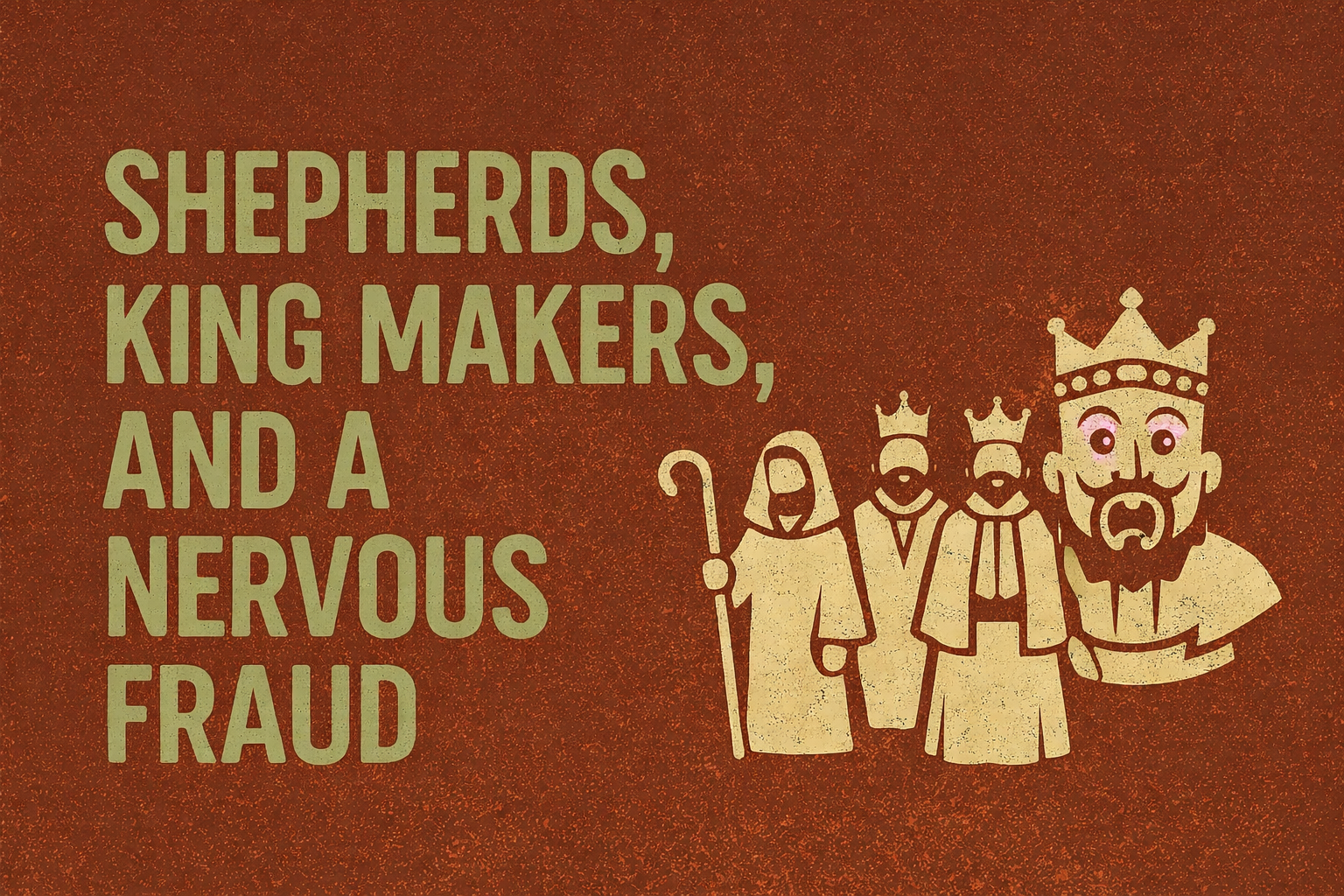
He begins with shepherds in a field at night. Outside Bethlehem. Working. Watching. Likely young. Likely overlooked. Likely unwashed.
Shepherding was not a glamorous job. It was necessary work, often done by those with little status. These were not the people you would choose to receive the first announcement of the Messiah.
And that is exactly the point.
God does not send the first birth announcement to the polished and powerful. He sends it to the ordinary and the tired. To the ones who are keeping watch when most people are asleep.
Then the shock arrives.
“An angel of the Lord appeared to them, and the glory of the Lord shone around them, and they were filled with great fear” (Luke 2:9).
That fear makes sense. We read this story every December, so we forget how startling it is.
Most of Israel had not seen an angel for generations. There had been centuries of waiting, silence, ache, and longing. People still had Scripture. They still had the promises. But heaven breaking into earth like this felt rare.
And then, suddenly, the night splits open.
The first words are not sentimental. They are stabilizing.
“Fear not” (Luke 2:10).
That is what God says when he comes near. Not because the fear is silly, but because the fear is real. The world is cracked. Empires loom. Bodies break. Sin stains everything. And when God draws close, our hearts do not know whether to hide or hope.
So the angel speaks comfort and announcement together.
“I bring you good news of great joy that will be for all the people. For unto you is born this day in the city of David a Savior, who is Christ the Lord” (Luke 2:10 to 11).
A Savior. A King. The Lord.
That last word matters. Lord is not just a religious title. It is a claim. It is a challenge. It is a declaration that someone else is in charge.
And then heaven doubles down. A multitude of the heavenly host appears, praising God (Luke 2:13 to 14). This is not a quiet choir. It reads more like a shout from an army.
Peace on earth does not arrive because the world finally learned to behave. Peace arrives because God has come to take the world back.
Why The Shepherds Matter For You
The shepherds run to see the child. They find Mary and Joseph. They see the baby. They tell what they heard. Then they return, glorifying and praising God (Luke 2:15 to 20).
Notice what Luke is doing.
He is showing you the kind of people who get swept into the center of God’s story. Not the impressive. Not the powerful. Not the religious professionals with perfect timing.
Regular people. Working people. People with dirt on their hands and fear in their chest.
If you have ever felt like faith was for stronger people, this scene corrects you.
If you have ever assumed God mostly speaks to the important, this scene confronts you.
If you have ever carried the quiet thought that you are not the kind of person who gets included, this field outside Bethlehem tells you otherwise.
The first witnesses were not the ones you would choose. They were the ones God chose.
The Magi Are Not Cute Extras
Now Matthew shifts the scene.
“Now after Jesus was born in Bethlehem of Judea in the days of Herod the king, behold, wise men from the east came to Jerusalem” (Matthew 2:1).
We call them wise men or magi. We picture them like friendly visitors in a pageant, arriving with a slow camel parade while children wave.
Matthew does not present them as props.
These were serious men from the east. Educated. Connected. Wealthy enough to travel far and bring costly gifts. They were not random tourists. Their arrival carried weight.
They ask a loaded question.
“Where is he who has been born king of the Jews?” (Matthew 2:2).
That is not a sweet line for a Christmas card. That is a political statement inside a city ruled by a paranoid client king under Rome.
They are saying, in public, within earshot of power, that a new King has been born.
Their gifts reinforce it. Gold. Frankincense. Myrrh. Honor. Worship. Burial scent. This child is royal. This child is worth bowing to. This child will not remain a harmless infant.
The magi are king makers in the sense that their presence signals recognition. They are not crowning Jesus. God has done that. But they are testifying to it.
They show up as outsiders, and they see what many insiders miss.
Herod, The Nervous Fraud
Matthew’s next line is chilling.
“When Herod the king heard this, he was troubled, and all Jerusalem with him” (Matthew 2:3).
Herod is not just worried. He is threatened.
That is what happens when a fake king hears about a true King. Fear rises. Control tightens. Violence becomes thinkable.
Herod gathers the chief priests and scribes and asks where the Christ would be born (Matthew 2:4). They answer with prophecy from Micah. Bethlehem (Matthew 2:5 to 6).
Think about the irony.
The religious experts can quote the text. The magi go and worship.
Meanwhile Herod pretends devotion while plotting murder. He asks the magi for details, then tells them to report back so he can “come and worship him” (Matthew 2:8).
It is a lie.
Herod is a nervous fraud. He holds power, but not peace. He wears a crown, but he cannot bear rival claims. His fear exposes the pattern that repeats through history.
When false lords feel threatened, they harm the vulnerable.
Christmas is not only about comfort. It is also about exposure. The light reveals what is real.
Escape To Egypt And The God Who Protects His Promise
Matthew does not let the story end with starlight and gifts.
God warns the magi in a dream not to return to Herod (Matthew 2:12). Then an angel warns Joseph in a dream to flee (Matthew 2:13). Joseph takes Mary and Jesus and leaves in the night.
They escape to Egypt.
It is dangerous. It is disorienting. It is not the kind of scene we put on a Christmas ornament.
But Matthew says this is also fulfillment.
“This was to fulfill what the Lord had spoken by the prophet, ‘Out of Egypt I called my son’” (Matthew 2:15).
God is not improvising. He is protecting the story he is writing, even through threat and flight.
Then comes one of the darkest passages in the Gospels. Herod, enraged, orders the slaughter of the children in Bethlehem two years old and under (Matthew 2:16 to 18). Matthew ties the grief to Jeremiah’s words about Rachel weeping for her children.
This is the world the true King enters.
Not a clean world. Not a safe world. A world where power kills to stay in power.
And still, Jesus comes.
Not as a mascot. Not as a seasonal decoration. As King.
Where Have You Made Christmas Too Safe?
This is the question that lingers.
Where have you made Christmas too safe?
Maybe you have turned Jesus into a comforting idea, but not a commanding Lord.
Maybe you have kept him in the manger so you do not have to face what he demands in your habits, your money, your relationships, your politics, your loyalties, your private compromises.
Maybe you love the comfort of “peace on earth” but resist the implication that peace comes with a new ruler.
The shepherds, the magi, and Herod each give you a mirror.
The shepherds show you that Jesus welcomes the ordinary and the overlooked.
The magi show you that real worship is costly and public.
Herod shows you what fear does when we cling to control.
Jesus is not only Savior. He is King.
