



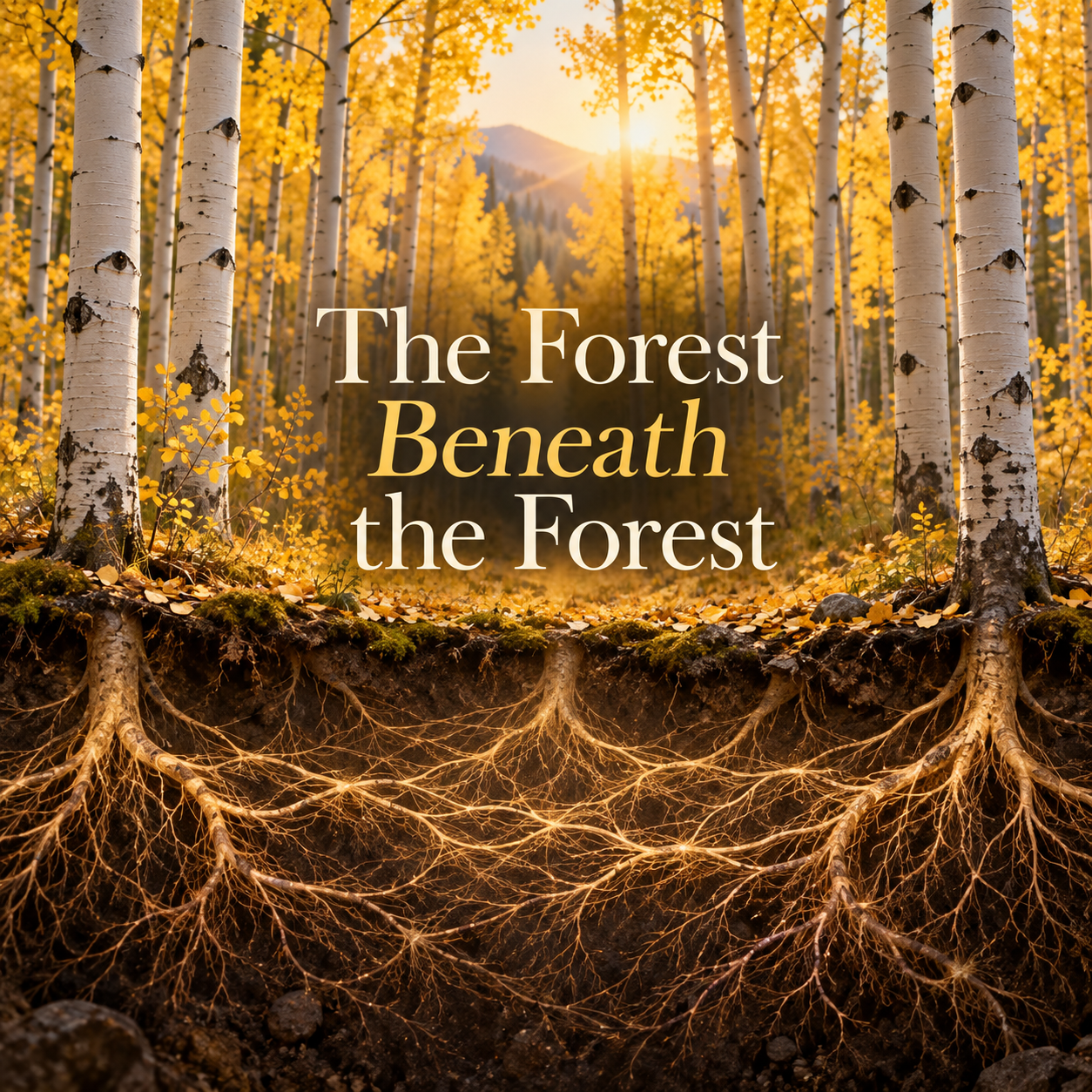
If you have ever driven through Colorado in the fall, you have probably seen an aspen grove lighting up the side of a mountain. Hundreds of white trunks stretch upward, covered with leaves turning brilliant yellow and gold. From the road, it looks like a forest filled with individual trees, each one standing beautifully on its own.
But what you are looking at may not actually be hundreds of separate trees.
Beneath the ground, many of those trunks may be connected to the same root system. What appears to be a collection of individual trees can actually be one living organism expressing itself in hundreds of different places. The most important part of what you are seeing is completely invisible.
You can photograph the leaves, count the trunks, and measure the height of the trees, but the source of their life, strength, connection, and ability to recover is hidden beneath the surface.
There is something profoundly Christian about that picture.
We naturally pay attention to what can be seen. We notice the sermon, the worship service, the Bible study, the mission trip, the growing ministry, the baptism, the changed life, and the acts of generosity. We notice the things God is doing that rise above the surface where everyone can see them.
Yet Scripture continually reminds us that visible fruit grows from invisible roots.
Jesus gives us this picture in John 15 when He says, “I am the vine; you are the branches.” The Christian life does not begin with what we accomplish for Jesus. It begins with our connection to Jesus. Before there is fruit, there is abiding. Before there is visible ministry, there is an invisible relationship with Christ from which everything else grows.
The same is true of the church.
What looks individual above the ground is often deeply connected underneath it. Paul describes the church as one body made up of many parts. We have different gifts, different callings, different personalities, and different places where God has planted us, but we share the same source of life. We belong to Christ, and because we belong to Christ, we belong to one another.
That becomes especially important when fire comes.
Aspens have relatively thin bark, which means wildfire can severely damage or destroy the visible trunks. Walking through an aspen grove immediately after a major fire, you might see blackened trees and scorched ground and assume that everything had been lost.
But the fire may not have reached the deepest part of the system.
When the underground roots survive, they can send up new shoots. Those shoots are not beginning from nothing. They are connected to a mature system beneath the surface that already has access to water, nutrients, and stored energy. What appears devastated above the ground can still possess remarkable life underneath it.
The Christian life has seasons like that.
Disappointment can feel like fire. Loss can feel like fire. A relationship that falls apart, a prayer that seems unanswered, a ministry that ends, a job that disappears, a diagnosis we never expected, or a season when God seems unusually quiet can leave us staring at the surface and wondering whether anything good remains.
But loss above the ground does not always mean death beneath it.
If our lives are rooted deeply in Christ, God can bring new life from places that appear burned over. The circumstances may change. The visible expressions of our lives may look completely different from what they once did. Yet the root system remains.
Perhaps that is why some of the most important questions we can ask are not about what everyone else can see.
Are we deeply rooted in Christ? Are we spending time in Scripture when nobody is watching? Are we learning to pray when there is nothing impressive to report? Are we connected to other believers who know us well enough to encourage us, challenge us, and carry burdens with us? Are our lives healthy enough beneath the surface that when difficulty comes, something new can eventually grow?
Jesus never promised that the forest above the ground would remain unchanged. Seasons come and go. Circumstances change. Churches change. Careers change. Relationships change. Things that flourish today may look entirely different ten years from now.
But Christ remains.
When our roots grow deeply into Him, we discover a kind of resilience that cannot be manufactured by appearances or activity. We can endure difficult seasons because our lives are drawing from something deeper than the circumstances immediately around us.
Healthy roots create resilient faith.
And some of the most important work God is doing in your life right now may be happening where nobody else can see it.
