


There is a moment most of us try to avoid. It is the moment when everything we trusted stops working. Plans collapse. Strength fades. Control slips. And we are left facing something we do not like to admit.
We cannot save ourselves.
In , Jonah reaches that moment at the bottom of the sea, inside the belly of a fish. His descent is not just physical. It is spiritual. Emotional. Total. Scripture traces it with a single direction repeated again and again: down. Down to Joppa. Down into the ship. Down into the sea. Down to the roots of the mountains.
This is what running from God looks like. Not always rebellion in the obvious sense. Often it looks like self reliance. Quiet confidence that we can manage life on our own terms. Until we cannot.
Jonah was not irreligious. He was a prophet. He knew God. But knowing about God is not the same as depending on him. And for Jonah, dependence did not come until there were no other options left.
“Then Jonah prayed.”
That word matters. Then. Not during the storm. Not when the sailors panicked. Not when the waves rose. Jonah prayed when he ran out of alternatives.
We do the same.
Crisis does not create belief. It reveals it.
From the depths, Jonah cries out using the language of death itself. He describes Sheol, the place of the dead. Darkness. Silence. Separation. In his own words, it feels like a living grave. And yet, something unexpected happens.
God hears him.
This is the turning point. Not that Jonah finds a way out, but that God is present even in the place Jonah thought was beyond reach. The depths are not outside God’s authority. The grave is not beyond his voice.
And that leads Jonah to a simple, profound confession:
“Salvation belongs to the Lord.”
Not partially. Not mostly. Entirely.
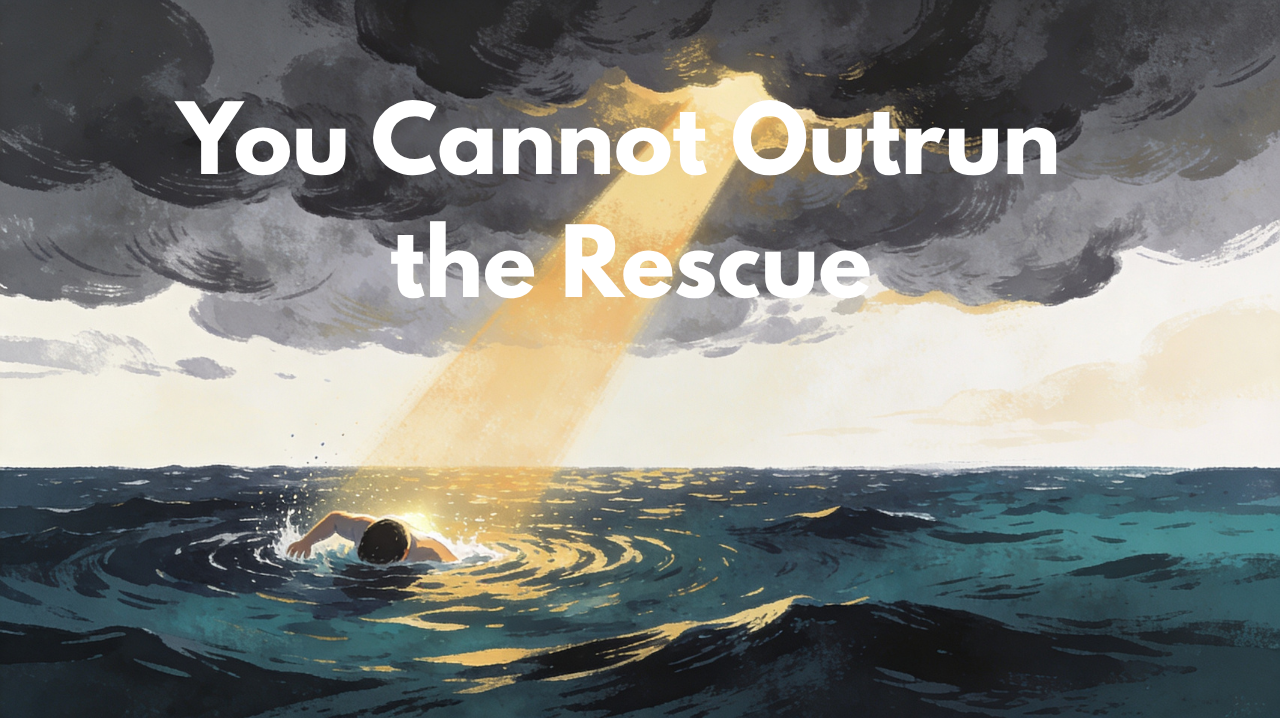
Jonah contributes nothing to his rescue except his need. He does not swim to the surface. He does not negotiate his way out. He does not improve his situation. God speaks, and the fish obeys.
That is how salvation works.
We spend much of our lives trying to prove otherwise. We build identities on performance. We cling to control. We assume that if we try harder, do better, or fix enough, we can secure our own way forward. But anything we build apart from God eventually collapses under the weight of reality.
Rock bottom exposes that truth.
But here is the good news. The bottom is not the end. It is often the beginning.
Because when self reliance finally gives way, surrender becomes possible. And surrender is not defeat. It is the doorway to rescue.
Jonah’s story points beyond itself. Jesus made that clear. Just as Jonah spent three days in the depths, so would he. But where Jonah experienced the grave, Jesus conquered it. He entered death and broke it from the inside.
Which means this:
There is no depth you can reach where God cannot find you.
No failure that places you beyond his grace.
No situation where the story is already over.
You cannot outrun the rescue.
And maybe the moment you feel most undone is the moment you are closest to discovering it.
